.png)
Blog: Red Light Efficiency, Why Better Light Is Not Always More Light

When people ask, “What makes red light therapy work best?” the answer is not just brighter bulbs, longer sessions, or standing closer to the light.
The real answer is efficiency.
In photobiomodulation, the technical name for red light therapy, efficiency means delivering the right wavelengths, at the right intensity, for the right amount of time, to the right tissue. When those pieces come together, the body can use that light more effectively.
That matters because red light therapy follows what researchers call a biphasic dose response. In simple terms, too little light may not create much change, the right dose can be helpful, and too much light may become less effective. More is not always better. Better is better. (PMC)
The Most Discussed Topic: Dose
Across current red light and photobiomodulation discussions, the biggest technical topic is dose.
Dose includes:
Wavelength
Irradiance, or power delivered to the skin
Fluence, or total energy delivered over time
Distance from the light
Session length
Frequency of use
Pulsing versus continuous wave
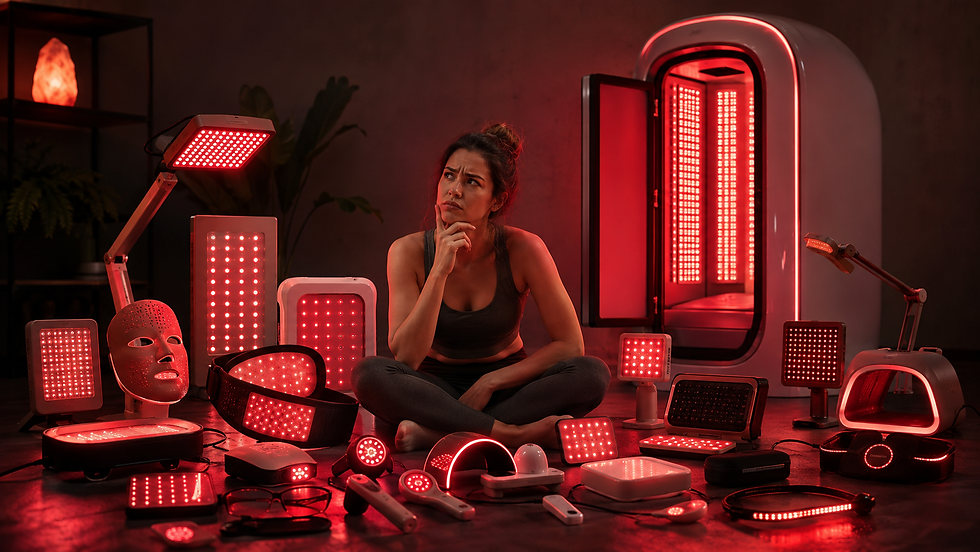
This is why two red light devices can look similar but perform very differently. A cheap red light panel may glow red, but that does not mean it is delivering an efficient therapeutic dose.
At The Wellness Center, this is one reason we use whole-body professional pods instead of small consumer lights. The goal is not just to shine red light on the body. The goal is to deliver usable light energy across a larger surface area in a controlled, repeatable way.
Wavelength Matters
Different wavelengths interact with the body differently.
Red light, often around 630 to 660 nanometers, is commonly discussed for skin, circulation, surface tissue, and cellular support.
Near-infrared light, often around 810 to 850 nanometers, is known for deeper penetration into muscles, joints, and connective tissue.
Our pods also include 940 nanometers, which is especially interesting because it is discussed in relation to circulation, blood flow, and deeper tissue effects.
The Wellness Center pods use four wavelengths:
633 nm
810 nm
850 nm
940 nm
That matters because the body is not one layer deep. Skin, blood, nerves, muscles, joints, and connective tissue all respond differently. A more efficient session gives the body a fuller range of light tools to work with.
The Mitochondria Connection
One of the main theories behind red light therapy is that specific wavelengths are absorbed by parts of the cell, especially the mitochondria.
The mitochondria help produce ATP, which is cellular energy. Research also discusses effects on nitric oxide, inflammation pathways, calcium signaling, and oxidative stress balance. (AIMS Press)
In simple language, red light does not force the body to heal. It gives the cells a signal and energy support so the body can do what it was already designed to do.
That is efficiency.
Pulsing: The Technical Part Everyone Is Talking About
Pulsing means the light turns on and off at specific frequencies instead of staying on continuously.
Continuous wave means the light stays steady.
Pulsed light is measured in hertz, or Hz. For example, 10 Hz means the light pulses 10 times per second.
The interesting part is that pulsing may change how the body receives the light. Some research suggests pulsed light can create different biological effects than continuous light, but the science is still developing. A major review concluded that pulsed light does appear to have effects that differ from continuous wave light, but more research is needed to define which pulse settings work best for which conditions. (PubMed)
That is important. Pulsing is not magic. But it may be a powerful way to fine-tune the session.
Why Pulsing May Improve Efficiency
Pulsing may help in a few ways.
First, it may allow tissue brief recovery moments between light bursts.
Second, it may reduce heat buildup compared with continuous delivery.
Third, it may create a different cellular signal than steady light.
Fourth, certain frequencies may be better suited for certain goals, such as relaxation, recovery, inflammation support, or nervous system support.
A 2025 study comparing pulsed and continuous wave modes found that pulsed laser irradiation may improve deeper tissue fluence while reducing skin temperature compared with continuous wave delivery. That does not mean pulsing always wins, but it does support the idea that pulsing can matter when efficiency and tissue targeting are the goal. (PMC)
Continuous Wave Still Matters
Continuous light is not “bad” or outdated.
In fact, continuous wave may be preferred in some cases, especially when the goal is calm, steady delivery. Some clients also tolerate continuous light better, and some protocols use it intentionally.
This is why customization matters. A quality red light session should not be treated like a one-size-fits-all tanning bed. Different people come in with different goals, sensitivities, histories, and nervous system states.
At The Wellness Center, we love that our pods allow wavelength control and pulsing options. That gives us more flexibility than a basic red light panel.
The Biggest Mistake: Chasing Intensity
One of the most common mistakes in red light therapy is assuming stronger is always better.
It is not.
If the dose gets too high, the body may not respond as well. That is the biphasic response again. Low to moderate doses may stimulate helpful cellular activity, while excessive exposure may reduce the benefit. (PMC)
That is why consistency usually beats intensity.
A smart red light routine is not about crushing one marathon session. It is about repeated, appropriate sessions that allow the body to respond over time.
For many people, every other day is a great rhythm. A course of sessions is usually more helpful than one random visit. We often recommend giving the body at least 6 sessions to begin noticing how it responds, and 12 sessions is a great starting course.
Why Whole-Body Pods Are Efficient
Whole-body pods have a unique advantage because they cover much more of the body at once.
Instead of treating one small area, the pod surrounds the body with red and near-infrared light. That means more tissue exposure, more consistency, and less guesswork.
Our sessions also include more than just light. At The Wellness Center, many sessions can include oxygen, vibration plate support, music, pulsing technology, and customized protocols.
That combination is part of what makes the experience different.
You are not just sitting in front of a lamp.
You are stepping into a full-body recovery environment.
So, What Works Best?
The most efficient red light therapy is not the brightest device, the longest session, or the most expensive gadget.
What works best is:
The right wavelengths
Enough power to matter
Not so much power that it overwhelms the body
A consistent schedule
Whole-body exposure when possible
Customized protocols
Pulsing when it fits the goal
Time for the body to respond
The future of red light therapy is not just more light. It is smarter light.
At The Wellness Center, that is exactly why we use professional whole-body pods with multiple wavelengths, pulsing technology, and protocol options designed for real people with real goals.
Whether you are working on pain, inflammation, recovery, stress, sleep, weight loss support, or overall wellness, efficiency matters.
Better light. Better delivery. Better consistency.
That is where red light therapy gets exciting.
Call The Wellness Center at 801-800-2484 or schedule your first session free at TheWellnessCenter.life.


Comments