.png)
Red Light Therapy Explained: The Most Searched Terms and What They Actually Mean
Red light therapy is suddenly everywhere.
People are searching for red light masks, near-infrared light, pain relief, inflammation support, collagen production, muscle recovery and cellular energy. They are also asking one very important question:
Does red light therapy actually work?
Interest in red light therapy has grown significantly in recent years, especially as red light masks and other home devices have become popular on social media. A Google Trends study examining phrases such as “red light therapy,” “light therapy,” “red light masks,” “red light therapy benefits,” “photobiomodulation” and “low-level laser therapy” found a major increase in public interest.
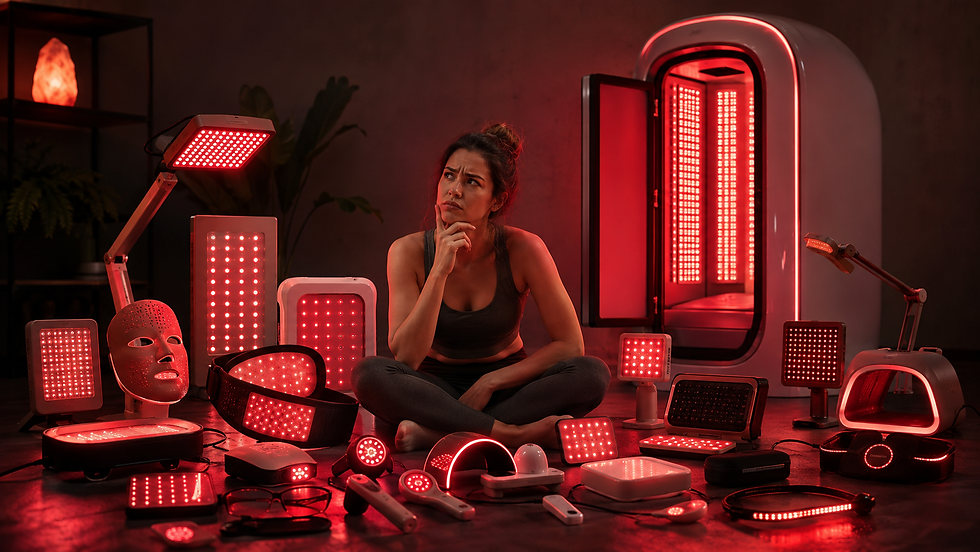
However, searching these terms can quickly become confusing. What is photobiomodulation? Is near-infrared light different from red light? What do mitochondria have to do with recovery? Is a facial mask the same as a whole-body red light therapy pod?
Let’s explain the most commonly searched red light therapy terms in language that actually makes sense.
What Is Red Light Therapy?
Red light therapy uses specific wavelengths of red and near-infrared light to interact with cells and tissues.
Unlike ultraviolet light, red and near-infrared light are not used to tan or burn the skin. Red light therapy is generally delivered through LEDs or low-level lasers and is designed to create a biological response without causing the tissue damage associated with high-powered surgical lasers.
The goal is not simply to shine a red-colored light on the body. The wavelength, strength, treatment time, distance from the light and total dose all matter.
What Is Photobiomodulation?
Photobiomodulation, often shortened to PBM, is the scientific term commonly used for red light therapy.
“Photo” means light.
“Bio” refers to the body.
“Modulation” means influencing or changing an activity.
Put together, photobiomodulation means using light to influence biological activity.
Researchers describe photobiomodulation as the application of red or near-infrared light to encourage cellular responses associated with tissue repair, inflammation regulation and pain modulation. It has also been called low-level light therapy or low-level laser therapy.
Red light therapy is the term most people use in everyday conversation. Photobiomodulation is the term you are more likely to see in scientific studies.
What Is the Difference Between Red Light and Near-Infrared Light?
Red light and near-infrared light are related, but they are not exactly the same.
Visible red light commonly falls around the 630 to 660 nanometer range. It is frequently studied for surface-level concerns involving the skin, including skin texture, collagen, fine lines and healing.
Near-infrared light has longer wavelengths that are invisible to the human eye. Commonly used wavelengths include approximately 810, 830 and 850 nanometers. Near-infrared light is often studied for deeper targets such as muscles, joints, nerves and other tissues.
This is why a small red light face mask and a professional whole-body system may provide very different experiences. The wavelengths, power, coverage and intended use may not be the same.
Research reviews frequently identify red light near 630 to 660 nanometers and near-infrared light near 810 to 850 nanometers among the most commonly studied ranges. However, there is no single perfect wavelength or dose for every goal.
What Do Mitochondria Have to Do With Red Light Therapy?
“Mitochondria” and “cellular energy” are two of the most common phrases used when explaining red light therapy.
Mitochondria are small structures inside most of your cells. Their job is to help convert nutrients and oxygen into usable cellular energy.
That energy is stored in a molecule called adenosine triphosphate, commonly called ATP.
Researchers believe certain wavelengths of red and near-infrared light can interact with light-sensitive molecules inside the mitochondria. One of the most frequently discussed is cytochrome c oxidase, which is involved in cellular energy production.
This interaction may temporarily influence ATP production, nitric oxide, oxidative signaling and other processes that affect how cells respond to stress or injury. Researchers are still studying exactly how these mechanisms work under different treatment conditions.
Red light therapy does not provide the body with energy like food does. It may help support the processes cells use to produce and manage their own energy.
Red Light Therapy for Inflammation
“Red light therapy for inflammation” is one of the most common reasons people begin researching this technology.
Inflammation is part of the body’s natural response to injury, stress, infection or overuse. Some inflammation is necessary for healing. However, inflammation that becomes excessive or prolonged can contribute to discomfort and delayed recovery.
Photobiomodulation has been studied for its ability to influence inflammatory signaling. Reviews describe changes involving nitric oxide, reactive oxygen species, cellular signaling pathways and inflammatory mediators.
This does not mean red light therapy cures every inflammatory condition. The results can depend on the cause of the inflammation, the area being treated, the wavelength, the dose and the individual.
Red Light Therapy for Pain Relief
Pain relief is another highly searched red light therapy topic.
Research has examined photobiomodulation for different forms of musculoskeletal discomfort, including certain joint, muscle and overuse conditions.
The possible effects may involve several overlapping processes:
Supporting normal inflammatory responses
Influencing circulation and nitric oxide
Supporting tissue recovery
Helping regulate cellular stress
Modulating some pain-related signaling
Pain is complex, and there is no one treatment that works for every person or every condition. Red light therapy should be viewed as a supportive wellness tool rather than a guaranteed cure.
Red Light Therapy for Muscle Recovery
Athletes and active adults frequently search for red light therapy in connection with muscle recovery, soreness and physical performance.
Exercise creates temporary stress within muscles. The body then needs time, nutrition, hydration and rest to repair and adapt.
Photobiomodulation is being studied for its possible ability to support cellular energy processes, reduce some markers of exercise-related stress and assist recovery. Results vary depending on whether light is used before or after exercise, the treatment dose, the wavelength and the type of activity.
Red light therapy does not replace sleep, hydration, proper nutrition or appropriate medical care. It may complement those recovery habits.
Red Light Therapy for Collagen and Skin Health
Red light masks have helped make the words “collagen,” “fine lines,” “skin rejuvenation” and “anti-aging” closely associated with red light therapy.
Collagen is a structural protein that helps support the firmness and strength of the skin.
Studies have explored whether repeated red and near-infrared light exposure may influence fibroblasts, collagen production, skin texture and signs of photoaging. Some controlled research has reported improvements in collagen density and skin appearance, although the size of the improvement varies.
These changes are generally expected to be gradual. Red light therapy is not an instant facelift, and responsible providers should not promise dramatic overnight transformations.
Red Light Masks Versus Whole-Body Red Light Therapy
Red light masks are among the most visible red light products online.
They are designed mainly for the face and are commonly marketed for skin texture, fine lines, redness and acne-related concerns. Their advantages include convenience, portability and the ability to use them at home.
However, a face mask only covers a limited area.
A whole-body red light therapy system exposes a much larger percentage of the body at the same time. Depending on the equipment, it may also provide multiple red and near-infrared wavelengths, greater overall coverage and professionally selected protocols.
This does not necessarily mean every whole-body system is better than every mask. Device quality varies widely. A small high-quality device may outperform a poorly designed full-body product.
The important questions are:
Which wavelengths does the device provide?
Does it include red light, near-infrared light or both?
How much of the body does it cover?
What is the power density?
How long is each session?
Is the treatment protocol appropriate for the intended goal?
Does Red Light Therapy Actually Work?
The honest answer is that red light therapy appears more promising for some goals than for others.
There is legitimate scientific research behind photobiomodulation. It is not simply a colored light or an invention created by social media.
At the same time, the marketing surrounding red light therapy often moves faster than the research. Treatment methods vary significantly between studies, and benefits found for one condition should not automatically be applied to every other health concern.
Researchers and medical experts continue to emphasize that results depend on the wavelength, dose, device quality, treatment area, frequency of use and reason for treatment.
Red light therapy should not be presented as a miracle cure. It is better understood as a noninvasive tool that may support certain biological processes when it is used appropriately and consistently.
How Often Should You Use Red Light Therapy?
“How often should I use red light therapy?” is one of the most common questions people ask.
There is no universal schedule that applies to every person, device or condition.
A small facial mask, a handheld light, a panel and a professional whole-body pod may all require different treatment times. A protocol intended for skin health may also differ from one intended for muscle recovery or joint discomfort.
More is not always better. Light therapies can have a dose-dependent response, meaning too little may not create the desired effect while too much may reduce the benefit.
The best schedule should consider:
The device being used
The wavelengths
The power density
The length of each session
The goal of treatment
The person’s health history
The manufacturer’s instructions
Professional guidance when appropriate
What Are Red Light Therapy Wavelengths?
A wavelength describes the distance between waves of light and is measured in nanometers, abbreviated as nm.
Different wavelengths interact with tissue differently.
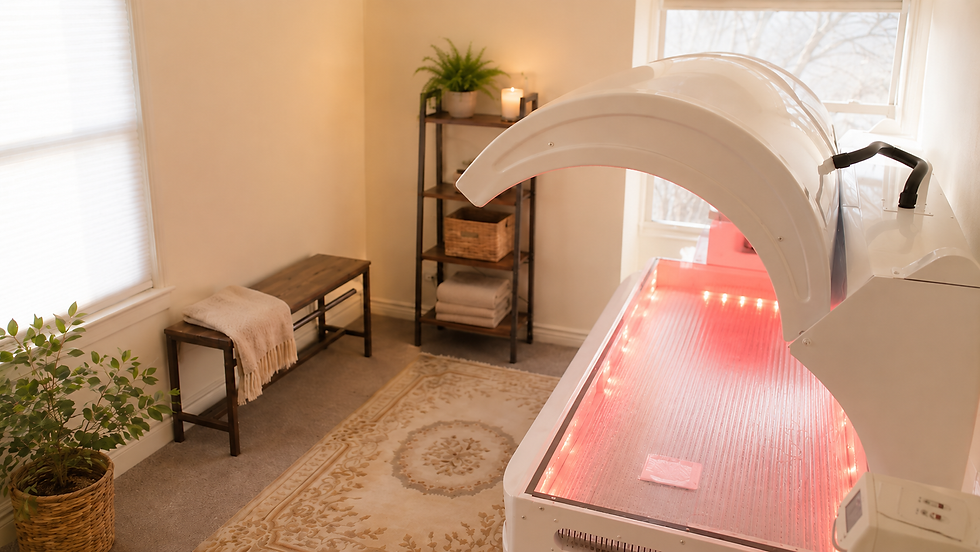
At The Wellness Center, our whole-body Q8 Regen Pods combine four wavelengths:
633 nm red light
810 nm near-infrared light
850 nm near-infrared light
940 nm near-infrared light
The goal of using multiple wavelengths is to provide broader coverage across surface-level and deeper tissues rather than relying on one wavelength alone. Our system also allows us to create customized whole-body protocols based on each client’s goals and experience.
Why Whole-Body Red Light Therapy?
Many of the most searched red light terms focus on one isolated benefit: skin, pain, recovery, inflammation or energy.
The body does not always work in isolated pieces.
Muscles, circulation, the nervous system, sleep, stress and cellular energy can all influence how someone feels. Whole-body red light therapy provides broad exposure rather than focusing on one small spot.
Our sessions take place in a comfortable full-body pod and generally last approximately 15 to 20 minutes. The experience is noninvasive, relaxing and does not involve needles or recovery time.
The Bottom Line
Red light therapy is the everyday name.
Photobiomodulation is the scientific name.
Red light is commonly used for more surface-level targets.
Near-infrared light is often selected when deeper penetration is desired.
Mitochondria help cells produce energy.
ATP is the usable energy molecule produced inside cells.
Collagen supports the structure of the skin.
Inflammation and pain are complex processes that red light therapy may help support, but results are never guaranteed.
Most importantly, not all red light therapy devices or treatments are equal.
The wavelengths, power, dose, body coverage, session time and treatment plan all matter.
Ready to Experience Whole-Body Red Light Therapy?
Your first session at The Wellness Center is free.
Experience medical-grade whole-body red and near-infrared light therapy using customized protocols created around your wellness goals.
The Wellness Center
Huntsville and South Ogden, Utah
The Light Meets You Where You’re At.


Comments